
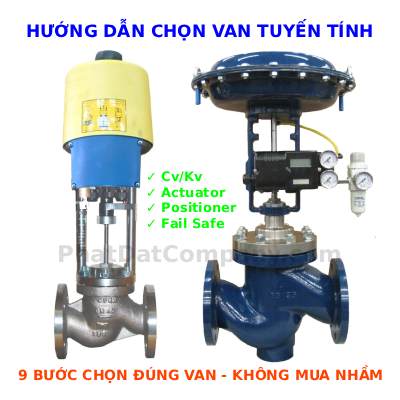
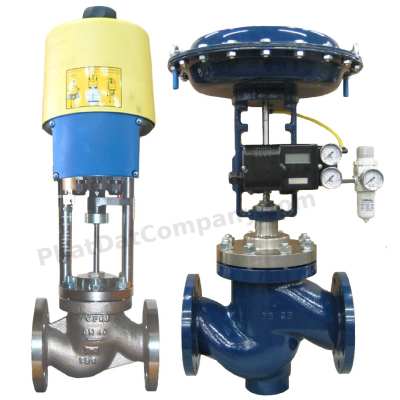
How to Choose the Right Globe Control Valves to Reduce Costs and Avoid Errors
Many factories purchase Globe Control Valves based on the following principles:
buying valves with the same brand name, buying valves with the lowest price, buying valves with the same old model name.
This is a major cause of system errors:
temperature fluctuations, steam loss, rapid seat wear, weak actuator force, unstable positioner operation.
Choosing the right valve from the start will significantly reduce costs.
.jpg)
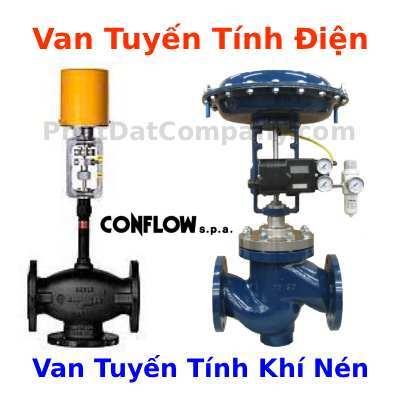
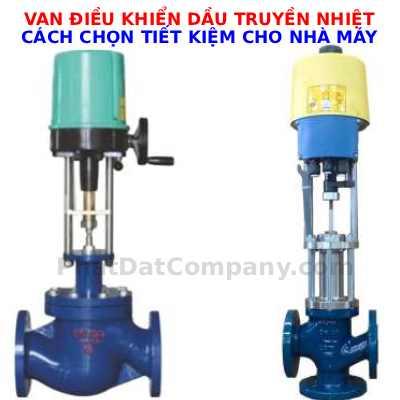
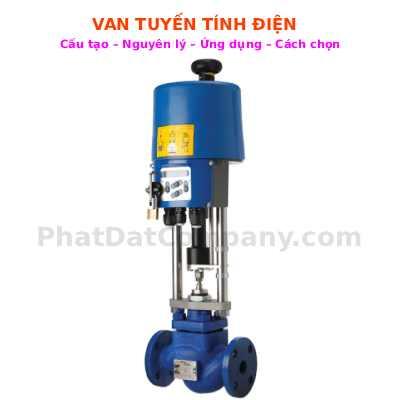
Choosing the right globe control valve helps reduce plant operating costs.
Besides choosing the right technology, cost is also a crucial factor when investing in a system. You can refer to the price list of linear control globe valves to compare sizes, materials, and control types to find the most suitable option.
1. Why does choosing the wrong Linear Globe Control Valves increase operating costs?
Common mistake:
DN50 pipe = choose DN50 valve.
This is incorrect.
Valve selection should be based on:
Cv
flow rate
pressure
temperature
pressure drop
DN is only a reference.
Example:
A DN80 line can have a DN50 valve if Cv is suitable.
2. How to calculate Cv to select the correct linear control globe valve
Cv is the most important factor.
If Cv is too large:
→ valve operation will be unstable
If Cv is too small:
→ underload
In practice:
The valve should operate stably at:
20% – 80% stroke
This is the best control range.
.jpg)
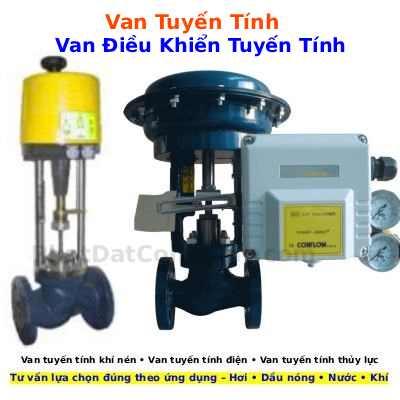
Correct Cv calculation ensures stable operation of the linear valve and reduces hunting.
Practical experience in selecting linear globe control valves
After many years working with boiler systems, heat transfer oil, textile dyeing, food processing, and heating lines, a very common mistake is selecting a linear control globe valve that is too large for the actual load.
Many engineers or purchasing departments often choose based on pipe size (e.g., if the pipe is DN50, they choose a DN50 valve), but in reality, this is the most wasteful method.
In linear control, the important factors are not pipe size, but:
actual flow rate
pressure difference across the valve
working temperature
appropriate Cv coefficient
Practical example:
A tank heating system using saturated steam, main pipe DN50, but the actual flow rate is only equivalent to DN32. If choosing a DN50 valve:
The valve usually only opens 5–10% of its stroke, making control difficult and unstable. It is prone to hunting (continuous oscillation), the seat wears out quickly, and steam consumption is higher.
After recalculating Cv and switching to a DN32 valve:
The working stroke is more stable at 35–60%, the temperature is more consistent, steam consumption is significantly reduced, and the valve and positioner lifespan are increased.
Practical experience shows that:
A linear control globe valve operates best when the working stroke is consistently between 30%–80%.
If the valve runs too small:
→ prone to errors
→ difficult to control
If the valve runs near full stroke continuously:
→ insufficient power
→ reduced control accuracy
Therefore, before purchasing a valve, it is advisable to calculate Cv or provide flow rate, pressure, and temperature parameters to ensure the correct selection from the start. Choosing the right valve not only stabilizes the system but also significantly reduces operating costs in the long run.
3. Choosing the Right Actuator Force
Calculations to consider:
Shutoff pressure
Spring force
Stem force
Actuator size smaller than required:
→ valve does not close tightly.
Applications:
Boilers
Compressed air preferred.
Heat transfer oil
Requires a high-temperature resistant seat.
Beer
Stainless steel preferred.
Confectionery
Requires high thermal stability.
Flour
Prioritizes dust resistance and stability.
Textile dyeing
Requires smooth modulating.
Rubber
High temperature variations in load.
Leather shoes
Continuous heating.
Wood
Drying line requires stable PID.
Applications of Linear Globe Control Valves in Thermal Oil Boilers and Textile Dyeing
Linear valves have practical applications in many thermal industries.
Common Mistakes When Selecting Linear Control Ball Valves
After many cases:
Most Common Mistakes:
1. Selection based on DN (Density)
Incorrect.
2. Selection based on Price
Cheap but prone to failure.
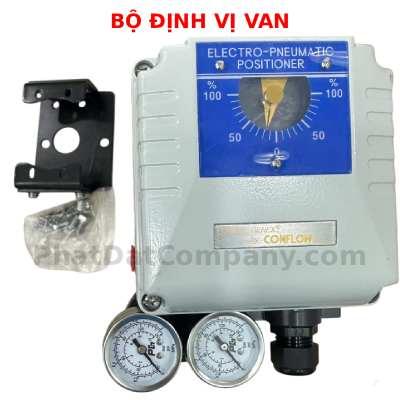
3. Not using a positioner
Easily leads to incorrect stroke.
4. No AFR (Automatic Flow Rate)
Contaminated air causes positioner malfunction.
Phat Dat Support:
✅ Free CV Calculation
✅ Application-Based Consulting
✅ Suitable Actuator Selection ✅ Correct Positioner Selection ✅ Correct Temperature Seat Selection ✅ Complete CO-CQ Documentation
✅ Imported Goods
.jpg)
Actual installation optimizes performance and reduces operating costs
Frequently Asked Questions (FAQ)
Do linear valves need a positioner?
Yes, especially with 4-20mA.
Is selecting based on DN correct?
No. It must be selected based on CV.
Which is better, pneumatic or electric?
Steam generally prefers pneumatic.
Why is the valve operating erratically?
This is often due to selecting an excessively large CV or incorrect PID tuning.
Are you looking for a linear control globe valve for:
boilers
heat transfer oil
beer
confectionery
flour
rubber
leather shoes
textile dyeing
wood
Contact Phat Dat for support:
✔ CV calculation
✔ Correct size selection
✔ Correct actuator selection
✔ Correct positioner selection
✔ Reduce hunting
✔ Reduce steam loss ✔ Quick quotation