
What is a Linear Valve? Structure and Operating Principle
Initially, factories only used manual valves or on/off ball valves to regulate steam. However, as the demand for precise control increased in the food, pharmaceutical and chemical industries, pneumatic or electric linear valves were born.
Since the 1970s, European companies such as SAMSON (Germany) and ARI-Armaturen have developed the first generation of linear globe valves, which can meet continuous linear control with high precision and a life span of more than 10 years in an environment with temperatures above 200°C.
Currently, linear valves have become the standard in steam factories, helping to save energy up to 15–30% compared to on/off control systems..webp)
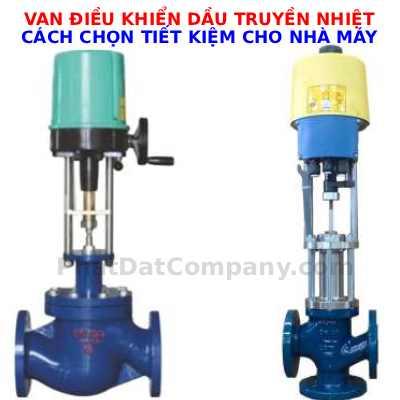
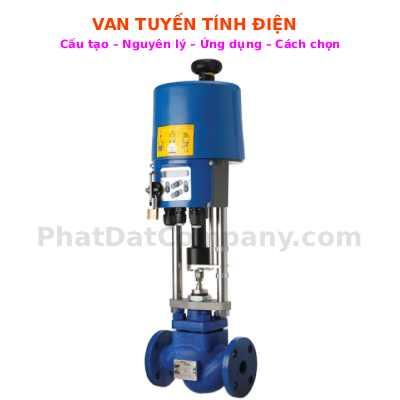
Linear Valve
What is a Linear Valve?
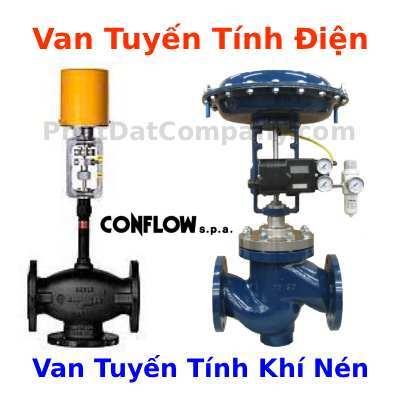
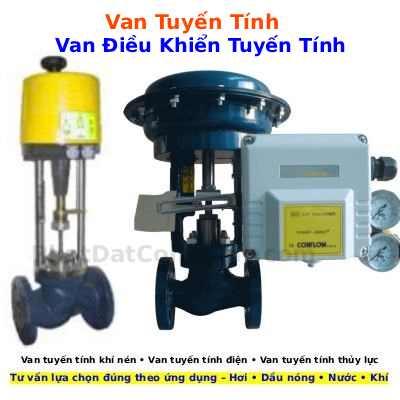
Linear control valve is a type of flow control valve in which the stem/plug moves in a linear direction (up-down) instead of rotating, helping to regulate flow, pressure or temperature accurately.
In steam applications, linear valves help regulate the amount of steam, steam pressure or condensate passing through, not simply on/off like gate valves or ball valves.
Common technical terms
Control Valve is a control valve (linear or on/off)
Actuator Actuator (pneumatic, electric, hydraulic)
Positioner Valve positioner, which provides precise control according to the 4-20mA signal
Linear Travel Linear travel (straight up and down) of the valve shaft
Cv (Flow Coefficient) Flow coefficient, which indicates the valve's regulating ability
Steam Pressure Steam pressure, usually from 2–40 bar
Steam Temperature Steam temperature, from 150°C – 400°C
Summary of technical benefits:
Precise control, fast response (<1s).
Optimize steam and energy consumption.
Easy connection with PLC/SCADA in automation systems.
Reduce pressure fluctuations, protect turbines, heat exchangers and pipelines.
High durability, 24/7 operation in harsh environments.
.webp)
Linear Valve
Structure of Linear Valve
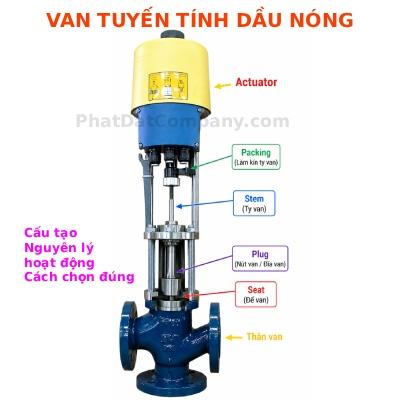
A steam control linear valve usually consists of 5 main parts:
1. Valve Body
Is the part that can withstand the highest pressure and temperature in the entire valve.
Commonly used materials:
Ductile iron (GGG40) - for low pressure steam < 10 bar
Carbon steel (GS-C25 / WCB) - for medium industrial steam 10–25
bar
Stainless steel (SS304, SS316, CF8M) - for clean steam, pharmaceutical or
food
Connection type: DIN flange PN16, PN25, PN40 or ANSI Class 150/300
Inside the body there is a flow chamber and a valve seat.
2. Valve disc (Plug)
Designed in a conical or parabolic shape, helping to regulate linear flow along the shaft travel.
The material is usually 316L stainless steel, hard coated with Stellite to prevent abrasion.
Some high-end models use balanced plug - balancing pressure on both sides, helping to reduce the control force from the actuator.
3. Valve shaft (Stem)
Connecting the plug and actuator, moving linearly up and down.
Made of 304/316 stainless steel with a polished surface, reducing friction and increasing tightness.
The upper part of the shaft has a packing gland and graphite seal to prevent air leakage.
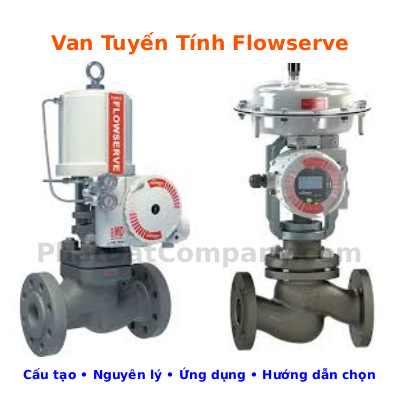
4. Actuator
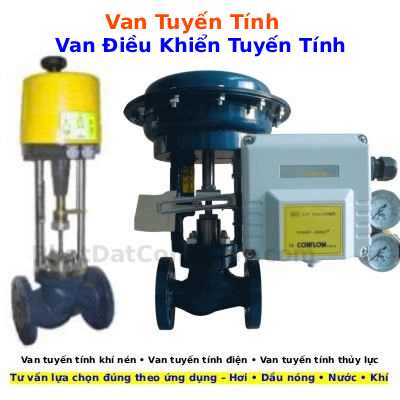
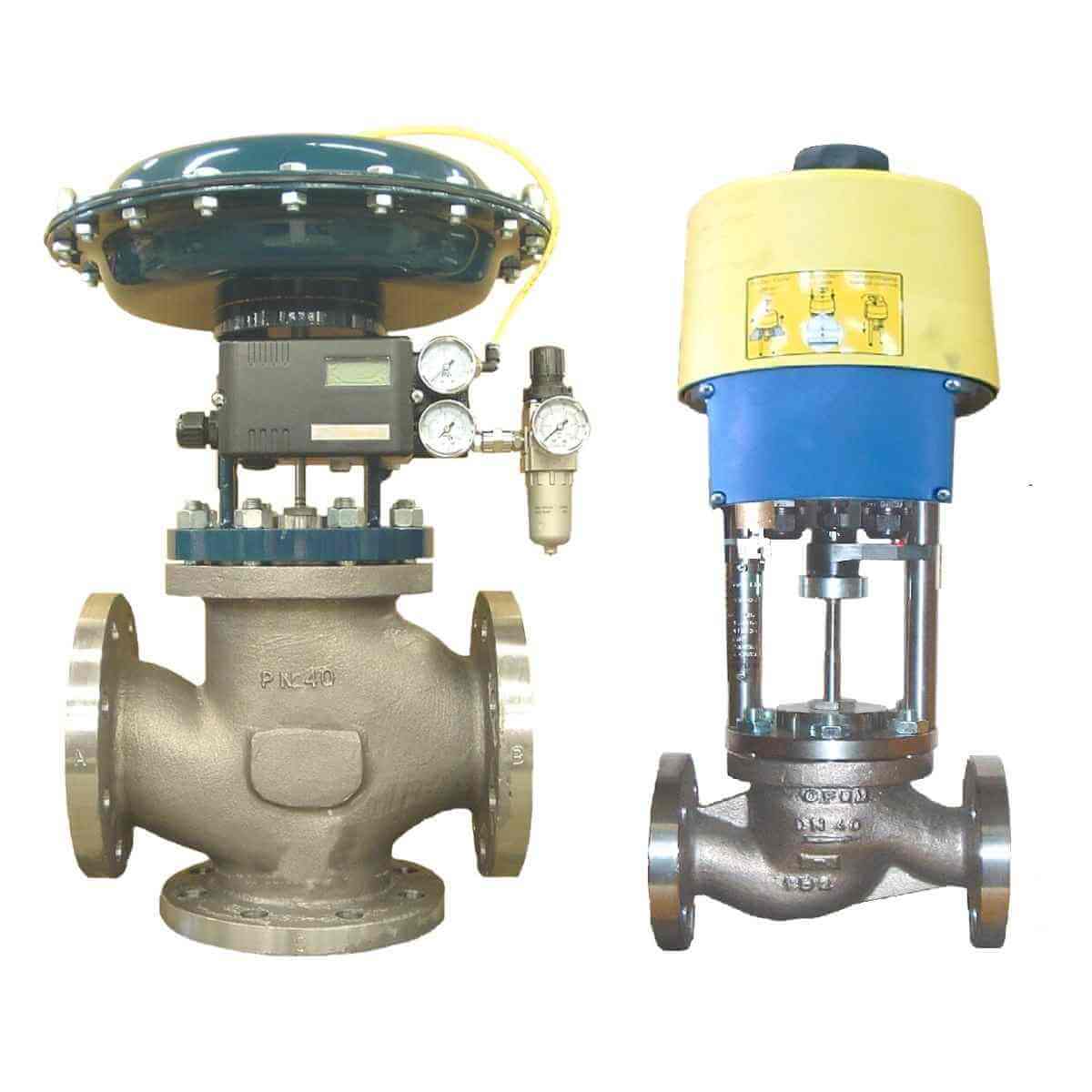
There are 2 common types:
Pneumatic actuator - using pneumatic control signals 0.2–
1.0 bar or 4–20 mA.
Electric (electric actuator) - controlled by electrical signals, often integrated with a position feedback circuit.
Main function: converts control signals into mechanical movements, acting on the valve shaft.
5. Positioner
Is the "heart" of the linear control valve.
Receives a 4-20 mA signal from PLC/DCS → adjusts the air pressure into the actuator → accurately controls the position of the plug.
Common types:
Pneumatic positioner
Electro-pneumatic positioner
Smart positioner (HART, PROFIBUS, FOUNDATION Fieldbus)
Operating Principle of Linear Valve
Assume the steam system needs to maintain a stable output pressure of 6 bar, while the input pressure is 10 bar. The controller will compare the actual value (PV) and the set value (SP):
1. When the output pressure is lower than 6 bar → PLC sends a 4–20 mA increase signal to the positioner.
2. Positioner opens the compressed air supply to the actuator chamber → the valve shaft pushes down, widening the gap between the plug and the seat → the steam flow increases.
3. When the output pressure reaches 6 bar → the positioner readjusts the air signal → the plug stops at the equilibrium position.
4. If the output pressure increases too much → the positioner reduces the air pressure → the plug moves up, narrowing the gap.
This process takes place continuously, according to the linear control mechanism (modulating control) to help maintain stable pressure and temperature throughout the steam system.
Advantages of Linear Valves
The advantages of linear valves include:
Accurate, smooth and stable control: Linear valves have the ability to respond accurately to control signals (4–20 mA), allowing pressure and steam flow to be regulated at an error level of < ±1%. Practical applications: temperature control in boilers, breweries, food steamers.
Energy saving & reduced steam loss: Because there is no "sudden opening/closing" phenomenon like with ON/OFF valves, the steam flow is more stable, avoiding thermal shock - helping to reduce steam consumption and energy loss by about 10–15%.
Increase the life of piping systems and heat exchangers: Stable steam flow → limit pressure fluctuations → avoid cracks and leaks on pipes and welds. Very important for heat exchanger systems, turbines or large boilers.
Easy integration with automation systems (PLC / SCADA): Smart valve positioner with HART / 4–20 mA / Profibus signal available → easy connection, monitoring and remote control.
Reduce long-term maintenance costs: Valve parts (seat, plug, packing) are made of hard, high-temperature resistant stainless steel, easy to replace. The system operates 24/7 without regular maintenance.
Suitable for many different environments: A rich range of materials (cast iron, WCB, stainless steel 316, PTFE, graphite seal...) helps CONFLOW linear valves - or equivalent - operate well in saturated steam, superheated steam, or clean steam environments.
Disadvantages of Linear Valves
Higher investment cost than ON/OFF valves: Although the initial cost is about 2-3 times higher, the long-term life and stability make the total life cycle cost (LCC) significantly lower.
Requires a control source (pneumatic or electric): The solution is in the steam system, which usually already has compressed air → just need to add a solenoid valve and air supply pipe.
Requires initial installation techniques: Requires an engineer with experience in adjusting the stroke and feedback signal. However, modern lines (such as SAMSON, or CONFLOW s.p.a) have an auto-calibration mode, which helps to self-calibrate after installation.
Large size and weight than ON/OFF valves of the same size: Due to the addition of an actuator and positioner, but the benefits in performance and stability far outweigh this limitation.
Applications of Linear Valves
In industrial steam systems, accurately adjusting steam pressure and flow is a key factor to help:
Keep the temperature stable for the production process.
Reduce energy loss and condensation.
Improve heat exchange efficiency, reduce boiler losses.
Linear valves are the devices that undertake this task.
Steam control valves act as the “regulating heart” of the system — automatically opening, closing, or adjusting according to control signals to ensure that steam supplies the correct flow rate, at the right time, and at the right design pressure.
Practical applications & experience from Phat Dat Company
With more than 10 years of experience in the field of industrial steam measurement and control, Phat Dat Company has implemented many projects to install CONFLOW linear control valves for boiler systems, autoclaves, and heating lines. In a practical application at a food factory in Binh Duong, replacing the pneumatic ball valve with a 0–10 V CONFLOW linear valve stabilizes the steam pressure at 6 bar, reduces temperature fluctuations to ±1°C and saves more than 12% of steam consumption.
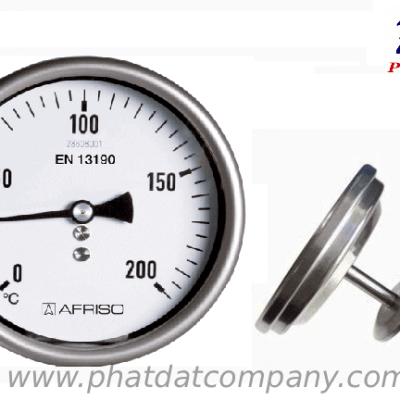
We use the PID NX 200 controller of manufacturer CONFLOW, combined with AFRISO pressure sensor to adjust PID accurately, ensuring safety and optimal performance for the system.
Phat Dat Company is the official distributor of AFRISO equipment - Germany in Vietnam. All products have clear CO/CQ, detailed technical instructions and are supported for installation and calibration on site by a team of experienced engineers.
.webp)
.webp)
.webp)
Installing the CONFLOW linear valve
How is a Linear Valve Selected?
Purpose of choosing the right linear valve
Choosing the right type of steam control linear valve directly affects:
Heat transfer efficiency.
Process stability (temperature, pressure).
System durability and operating costs.
An unsuitable hot steam linear valve (wrong pressure range, Cv or material) can lead to:
Leaks, corrosion, or seat wear after just a few months.
Loss of precise control or pressure fluctuations.
10–20% higher steam and energy consumption.
Factors to consider when choosing a linear valve for hot steam
Working pressure. Steam typically operates in the range of 2–25 bar. Valves with PN16 – PN40 (equivalent to Class 150 – 300) should be selected. For example, superheated steam systems should choose PN40.
Saturated steam temperature ~180–220°C, superheated steam can reach 350°C. Choose good heat-resistant materials: Stainless steel 316, seat PTFE/Graphite.
Steam flow needs to be regulated. Based on boiler capacity, or heat load. Need to calculate Cv (Coefficient of Flow) to choose the right valve size.
Control signal type. 4–20 mA, 0–10V, or compressed air 3–15 psi. CONFLOW valve supports a variety of: compressed air / electric / smart positioner (HART).
Working environment (pipe material). Affects corrosion
and life. If it is clean steam → choose Stainless steel 316L. If it is technical steam → use WCB or ductile iron.
Connection type. Threaded, flanged, welded. Steam industry often uses flanged
PN16/PN25 to ensure tightness.
Control accuracy. Depends on flow characteristics (linear / equal %). CONFLOW linear valves can optionally have linear (Linear) or proportional (Equal %).
How to Install Linear Valves
Proper installation helps linear valves operate stably, avoid vibration, leakage and prolong the life of the equipment. Below are the technical standards recommended by Ari-Armaturen, Samson, and CONFLOW.
Check before installation
1. Make sure the pipeline is clean, free of dust, rust, or condensate.
2. Check that the steam flow direction matches the arrow on the valve body.
3. Confirm that the working pressure and temperature are suitable for the valve parameters (PN, DN).
4. Place the valve in a position that is easy to operate and maintain, avoid hidden corners or too close to the wall.
Installation direction of linear valves:
The valve should be installed vertically, with the valve shaft facing upwards.
Avoid placing the actuator facing downwards, as it is easy to accumulate water or condensate.
Keep the shaft deviation ≤ 1°, ensuring the valve is completely closed.
If it is a pneumatically controlled linear valve, an air filter regulator must be installed before the actuator.
Connect and test the control signal:
Check the 4-20mA or 0-10V control signal source for correct polarity.
Calibrate the positioner so that the valve responds correctly to the PLC signal.
When starting up for the first time, run a 0%, 50%, 100% signal test to check the linearity.
Check for leaks at the flange, thread, or clamp with soap solution (do not use fire).
Where to Buy Linear Valves?
When choosing to buy linear valves, customers should look for:
• Genuine distributor with clear CO-CQ
• Technical support for on-site installation
• Goods available in stock, direct warranty in Vietnam
In Vietnam, Phatdatcompany is the exclusive distributor and trusted technical partner of CONFLOW (Italy), specializing in providing:
• CONFLOW steam control linear valves
• Pneumatic linear valves, electric linear valves
• Pressure measuring devices, pressure gauges, valve accessories and industrial fittings
Website: www.phatdatcompany.com
Hotline: 0989286139 (24/7 technical support)
Delivery and technical support 24/7
Phatdatcompany has CONFLOW linear valves in stock in Ho Chi Minh City, ready to deliver nationwide:
Free shipping within the city
Fast delivery within 24 hours for popular models (DN15–DN100)
24/7 on-site technical support: installation instructions, calibration, and control signal testing
Provide CO-CQ documents, catalogs, detailed installation instructions for each type of valve
How is linear valve delivery?
Phatdatcompany provides nationwide delivery service:
Southern region: delivery within 24 hours (HCMC, Binh Duong, Dong Nai).
Central – Northern region: delivery within 2–4 days via Viettel Cargo, GHN, or North–South transport.
Bulk or large quantity goods: can be delivered on pallets, containers, or sent according to customers' specific requirements.
All products are packaged shockproof – moisture-proof – sealed with Phatdatcompany brand.
Customers can contact via Zalo / Email / Hotline for support in choosing models, calculating Cv, or designing valves suitable for the steam system in use.