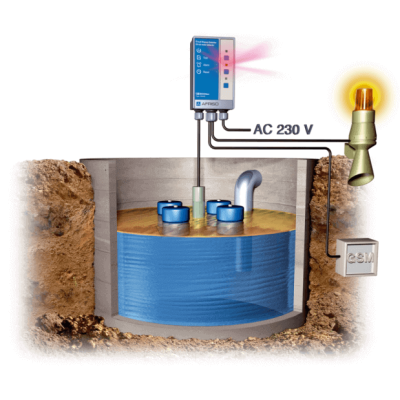

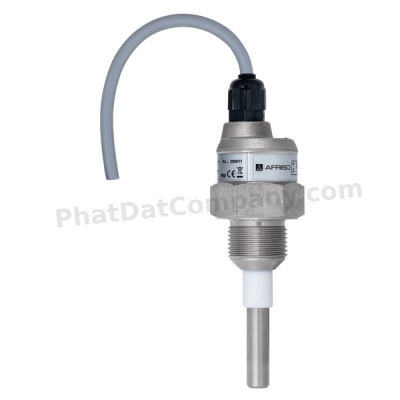
When does a factory need a high-temperature oil level switch?
Traditional float switches work well with water or oil at low temperatures. However, when applied to 100°C hydraulic oil, heat transfer oil, fuel oil (FO), or some industrial chemicals, mechanical floats can jam, age, or lose reliability after prolonged use.
That's why factories often switch to capacitive level switches like the CapFox ENT20/ENT21 AFRISO. The device uses no moving parts, withstands high temperatures, and is capable of accurately detecting liquid levels to control pumps, solenoid valves, or send warning signals.
In this article, we will analyze the operating principle, advantages and disadvantages, practical applications, and experience in selecting the appropriate oil level switch for each type of tank in a factory.
Practical Experience
During the process of advising on level measurement equipment for many factories in Vietnam, we have noticed that most customers focus only on cost and pay little attention to the operating temperature, dielectric constant of the fluid, or type of output signal. As a result, after a few months of operation, the level sensor operates unreliably, causing false alarms or failing to shut off the pump when the tank is empty.
For hydraulic oil, heat transfer oil, and diesel oil systems operating continuously, choosing the right type of level switch from the start will significantly reduce maintenance costs and minimize downtime.
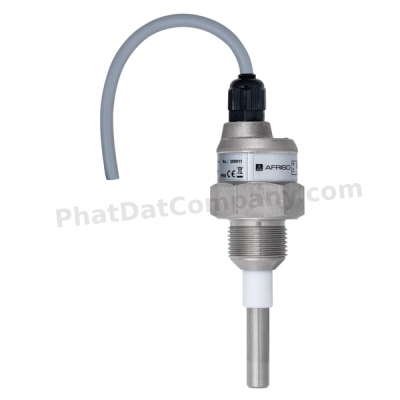
CapFox ENT20/ENT21 AFRISO is a capacitive oil level switch used to indicate low and high levels in industrial oil systems.
When does a factory need an oil level switch?
Not every tank needs a 4–20mA continuous level measuring device. In many applications, what the factory needs is simply to know:
• Is the tank empty?
• Is the oil full?
• Does the pump need to stop?
• Does the alarm need to sound?
This is the function of the oil level switch.
Instead of continuously measuring the liquid height, the device only detects when the oil level reaches the probe position and switches ON/OFF to control the system. Typical applications include:
• Protecting oil pumps from dry running.
• Diesel fuel tank full indicator.
• Automatic fuel pump control.
• Solenoid valve control.
• Low level warning in hydraulic oil tanks.
• Heat transfer oil level indicator.
• Fuel oil level indicator.
• Heat-resistant chemical level indicator.
For these systems, using a continuous level transmitter often increases investment costs while the required function is simply an on/off signal.
Operating principle of CapFox ENT20/ENT21 AFRISO
CapFox ENT20/ENT21 operates on the capacitive level switch principle.
The sensor probe acts as one plate of the capacitor. The tank wall or counter electrode acts as the other plate.
When the probe is in the air, the capacitance between the two plates is small.
When oil or liquid surrounds the probe, the dielectric constant changes, causing the capacitance to increase.
The internal electronic circuit continuously measures this capacitance change. When the set value is exceeded, the sensor switches its output state:
• Relay
• PNP
• NPN
This signal is used to:
• Stop the pump.
• Start the pump.
• Control the contactor.
• Control the PLC.
• Sound an alarm.
• Control the solenoid valve.
Because there are no moving parts, the sensor does not experience float jamming or mechanical wear like traditional float switches.
Practical Applications of CapFox ENT20/ENT21 in Factories
The strength of the AFRISO CapFox ENT20/ENT21 lies not in continuous liquid level measurement, but in its ability to accurately detect a preset level for control or warning. Therefore, the device is widely used in industrial automation systems.
1. Diesel Fuel Tank Low Level Detection
This is the most common application.
When the fuel level drops below the probe position, the CapFox ENT20/ENT21 will:
• Stop the fuel supply pump.
• Sound an alarm.
• Send a signal to the PLC or DCS.
• Protect the pump from dry running.
Applications:
• Generator fuel tanks.
• Boiler fuel tanks.
• Diesel fuel dispensing stations.
• Day Tank.
2. Hydraulic Oil Level Indicator
In high-power hydraulic systems, oil temperature often fluctuates between 60–100°C, or even higher.
Compared to mechanical float switches, capacitive level switches have several advantages:
• No float jamming.
• Less affected by vibration.
• Stable operation in hot oil environments.
• No moving mechanical parts.
This is why many steel, cement, plastic molding, and mechanical factories choose this type of sensor.
3. Heat Transfer Oil Level Indicator
Heat transfer oil has very high operating temperatures.
If using a conventional float switch:
• The float may age prematurely.
• The seal may fail quickly.
• Errors increase over time.
CapFox ENT20/ENT21 uses the capacitive principle, making it more suitable for systems such as:
• Heat transfer oil furnaces.
• Heat Transfer Oil.
• Thermal Oil Systems.
4. Chemical Level Indicator
Some chemicals are unsuitable for float switches because:
• Corrosive.
• Leaves residue.
• Low density.
CapFox ENT20/ENT21 offers various probe material and configuration options to suit different fluids (material compatibility should be checked before selection).
5. Pump Protection
This is the most cost-effective application.
In practice, many pumps fail not due to poor quality but due to:
• dry suction
• cavitation
• oil loss
• no-load operation
A low-level oil switch costs only a fraction of the pump's value but can help avoid repair costs and downtime.
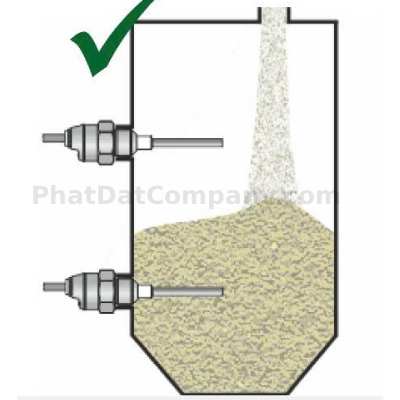
CapFox ENT20/ENT21 is installed to indicate low oil levels and protect hydraulic oil pumps in high-temperature environments.
Advantages of CapFox ENT20/ENT21 AFRISO
After many years of industrial deployment, we have found that the CapFox ENT20/ENT21 series has the following outstanding advantages:
High temperature resistance
This is the biggest advantage.
The device is suitable for:
• hydraulic oil
• heat transfer oil
• FO oil
• chemicals
at temperatures where many conventional float switches cannot meet the requirements (depending on the technical version).
No Moving Parts
Unlike float switches, the CapFox ENT20/ENT21 does not use:
• float
• shaft
• hinge
• spring
Therefore:
• reduced risk of mechanical jamming
• increased lifespan
• reduced maintenance
High Stability
The electronic circuit continuously monitors capacitance changes, so the on/off signal has good repeatability when properly set.
Simple Installation
The device has various thread types such as:
• G1/2
• G3/4
• G1
Easily integrated into existing tanks.
Easy to connect to control systems
Available versions:
• PNP
• NPN
• Relay
Easy to connect to:
• PLC
• Intermediate relay
• Contactor
• DCS
• HMI
Disadvantages of CapFox ENT20/ENT21
No single device is suitable for every application.
CapFox ENT20/ENT21 also has some points to note.
Higher cost than float switches
If the system only operates with diesel fuel at normal temperatures and requires simple operation, a float switch may be a more economical solution.
Correct selection based on fluid type is necessary
The principle of capacitance depends on the dielectric constant.
Therefore, it is necessary to provide the following information:
• type of liquid
• temperature
• pressure
• tank type
to select the correct model.
Do not replace continuous level sensors
CapFox ENT20/ENT21 indicates:
• level present
• no level present
If the customer needs:
• percentage display
• mm display
• liter display
• 4-20mA signal output
then a level transmitter should be chosen instead of a level switch.
Common mistakes when choosing oil level switches
This is the most common mistake customers encounter during consultation.
Mistake 1: Choosing based on price instead of working conditions
Many customers choose cheap switches but don't check:
• oil temperature
• pressure
• fluid type
As a result, the sensor operates unreliably or fails prematurely.
Mistake 2: Not checking the output signal
Some systems require:
• Relay
But instead, they buy:
• PNP
Or vice versa.
This necessitates adding an intermediate circuit when connecting to a PLC or contactor.
Mistake 3: Installing too close to the bottom of the tank
If the sensor is placed too close to the bottom:
• dirt accumulates
• false alarms
• difficult maintenance
Normally, it should be placed a suitable distance above the bottom of the tank, corresponding to the minimum safe oil level of the system.
Mistake 4: Not considering oil temperature
This is the most common mistake. Example:
• Hydraulic oil 100°C
• Heat transfer oil
If you choose a sensor that cannot withstand the actual temperature, its lifespan will be significantly reduced and the risk of machine downtime will increase.
Comparing CapFox ENT20/ENT21 with float switches and level electrodes
Choosing the right level switch depends not only on cost but also on the fluid temperature, reliability, and long-term operating costs.
CapFox ENT20/ENT21 Criteria Float Switch Level Indicator Electrode
Principle Capacitance Mechanical Float Conductive
Moving parts Yes No Yes No
Diesel Oil ⭐⭐⭐⭐⭐ ⭐⭐⭐⭐⭐ ✘
Hydraulic Oil ⭐⭐⭐⭐⭐ ⭐⭐⭐ ✘
Heat Transfer Oil ⭐⭐⭐⭐⭐ ⭐ ✘
FO Oil ⭐⭐⭐⭐ ⭐⭐ ✘
Chemicals ⭐⭐⭐⭐ ⭐⭐ Depending on type
High temperature resistance ⭐⭐⭐⭐⭐ ⭐⭐ ⭐⭐⭐
Maintenance Very low Medium Medium
PLC Control ✔ ✔ ✔
Contactor Control ✔ ✔ ✔
Lifespan Very High Medium High
Which oil level switch should I choose for each application?
This is a question that maintenance engineers and purchasing departments often encounter when selecting equipment.
Diesel Fuel Tanks
Recommendations:
✔ Float switch if temperature is low and simplicity is required.
✔ CapFox ENT20/ENT21 if high stability and PLC integration are needed.
Hydraulic Oil Tanks
Recommendations:
⭐⭐⭐⭐⭐ CapFox ENT20/ENT21
Reasons:
• High temperature resistance
• Low maintenance
• No float jamming
• Stable operation in vibrating environments
Heat Transfer Oil Tanks
Recommendations:
⭐⭐⭐⭐⭐ CapFox ENT20/ENT21
Conventional float switches should not be used as high temperatures can reduce the lifespan of the float and seals.
Chemical Tanks
Check:
• Probe material
• Temperature
• Corrosion resistance
• Dielectric constant
Then select the correct model.
Plants requiring high reliability
Examples:
• Cement
• Steel
• Thermal power
• Food
• Chemicals
• Oil and gas
Recommendation:
CapFox ENT20/ENT21 because the initial investment cost is higher but significantly reduces maintenance costs and downtime.
Why are many plants switching from float switches to capacitive sensors?
Through many consulting projects, the trend in recent years has been to gradually replace float switches with capacitive sensors in critical locations.
Reasons include:
• Reduced float jamming due to dirt and debris.
• Stable operation in vibrating environments.
• Withstands high oil temperatures.
• No moving mechanical parts.
• Longer lifespan under continuous operation conditions. Especially with 24/7 operating systems, reducing unplanned downtime can save significantly more money than the sensor itself.
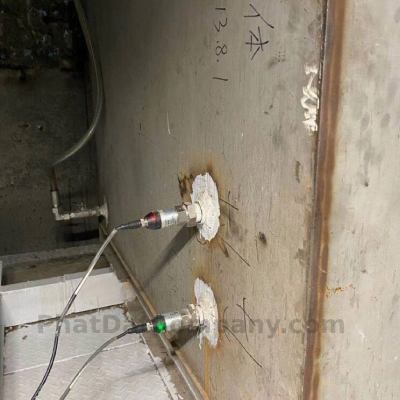
CapFox ENT20/ENT21 is installed to indicate low, high levels and protect pumps in industrial oil systems.
Why choose AFRISO?
✔ German brand with over 150 years of experience in measurement and control.
✔ Widely used in HVAC, fuel oil and industrial systems across many markets.
✔ Multiple versions available to suit:
• Diesel fuel
• Hydraulic oil
• Heat transfer oil
• Fuel oil (FO)
• Chemicals ✔ Supports multiple signal standards:
• Relay
• PNP
• NPN ✔ Easy integration with:
• PLC
• DCS
• SCADA
• Intermediate relays
• Contactors
FAQ
What is the difference between an oil level switch and an oil level sensor?
A level switch only detects at one point (ON/OFF), while a level sensor continuously outputs a 4–20 mA signal or displays the liquid level in mm, %, or liters.
Can CapFox ENT20/ENT21 be used for hydraulic oil up to 100°C?
Yes. However, the correct version must be selected according to the temperature, pressure, and probe material suitable for the actual working conditions.
Can a pump be controlled directly from CapFox ENT20/ENT21?
If the version has a relay output and a small pump capacity, direct control is possible within the specifications. For most industrial pumps, the sensor output should be used to control the contactor coil, not to directly switch the motor on or off.
Can it be used for fuel oil (FO) and heat transfer oil?
Yes, if the correct model is selected to meet the temperature and fluid characteristics. This is also one of the common applications of the CapFox series.
How often is calibration required?
In many ON/OFF level sensing applications, the device does not require periodic calibration like level transmitters. However, it is recommended to check its operation during system maintenance to ensure reliability.
Need advice on choosing the right oil level switch?
Each system has different requirements regarding fluid, temperature, pressure, installation type, and control signal. Choosing the right one from the start will help avoid false alarms, protect the pump, and reduce maintenance costs.
Phat Dat provides genuine AFRISO oil level switch solutions and also supports consulting on model selection according to the actual application of each plant, from diesel oil tanks, hydraulic oil to heat transfer oil and chemicals.
Conclusion
Not every system needs a 4–20mA continuous level sensor. In many industrial applications, the most important thing is to accurately detect when the oil is low or full to protect equipment and automate the operation process.
CapFox ENT20/ENT21 AFRISO is a capacitive oil level switch solution designed for industrial environments, especially suitable for:
• Diesel fuel tanks.
• Hydraulic oil tanks.
• Heat transfer oil.
• Fuel oil.
• Chemicals.
• Systems operating at high temperatures.
Thanks to the absence of a float mechanism, the device significantly reduces the risk of mechanical jamming, increasing lifespan and improving the reliability of the control system.
If your business needs a stable, long-lasting oil level indicator solution for industrial environments, the CapFox ENT20/ENT21 is a worthwhile option.
Unsure whether to choose ENT20, ENT21, or another solution?
Choosing an oil level switch depends not only on cost but also on:
• Oil type.
• Temperature.
• Pressure.
• Tank height.
• Mounting type.
• Signal type (Relay, PNP, NPN).
• PLC or contactor currently in use.
Phat Dat provides free consultation tailored to your factory's actual operating conditions, helping you choose the right model from the start, minimizing false alarms and reducing maintenance costs.